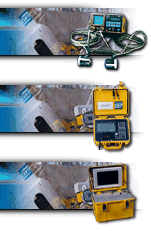
The CS 97 equipment

Controlling foundation length by the parallel seismic method.

Principle of the method

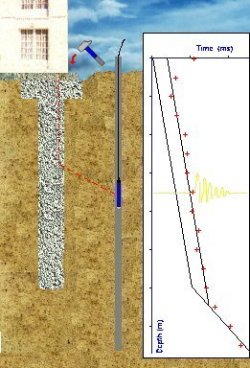
A reception probe is taken down a tube step by step. The tube is set in a drill located parallel to the foundation to scan. The vertical step can be chosen by the user on the CS 97 material (1 metre, or 20 or 50 centimetres). A 0.5 m step is advised.

For every position of the reception probe, a sound pulse is broadcast by a stroke a hammer gives to the foundation or to the structure carried by the foundation.

The hammer is fitted with a precise triggering device which causes the measurement to start as soon as it strikes the foundation.

Then, the sound wave propagates through the foundation.

The CS 97 unit records the signal received by the reception probe in the tube. The duration between the hammer stroke and the first arrival of the sound wave on the reception probe is measured.

The probe is taken 0.5 m lower down again, a new hammer stroke is given, and so on ...

The measurement terminates when the probe has reached the bottom of the tube.

If two operators make the measurement, it takes no more than about 25 minutes to wholly test a 20 metre deep drill.

It is worth noticing that one can take advantage of the drill to perform pressiometric measurements with the suitable material.
This is naturally to be performed before the tube is set and the concrete is injected.
Knowing the bearing capacity of the ground can be of a great help to evaluate the accuracy of the foundation length.

Introduction
Principle of the method
Setting the tube
Determining the length of a foundation
The Parallel Seismic software of the CS 97
The CS 97 equipment for the parallel seismic period
Composition of the equipment
Characteristics of the CS 97 equipment for the parallel method
Further informations